Section 38.2
Troubleshooting Flash Code 34, PID 102/FMI 4
This diagnostic condition is typically:
- Open sensor signal circuit
- Open sensor +5 volt supply circuit
- Sensor signal is shorted to sensor return circuit or to ground
- Sensor +5 volt supply is shorted to the sensor return circuit or ground
- Plugged or restricted air filter.
Section 38.2.1
Multiple Code Check
Perform the following steps to check for multiple codes.
- Plug the diagnostic tool.
- Turn vehicle ignition switch ON.
- Read active codes.
- If code p 102/4 was logged and there are no other logged codes, refer to "38.2.2 Sensor Check" .
- If code p 102/4 and any of the following codes p 73/3 or 4, p 94/3 or 4, p 100/3 or 4, p 101/3 or 4, p 110/3 or 4, p 174/3 or 4, p 175/3 or 4, were logged, refer to "79 Engine Harness" .
- If code p 102/4 was logged and none of the following codes p 73/3 or 4, p 94/3 or 4, p 100/3 or 4, p 101/3 or 4, p 110/3 or 4, p 174/3 or 4, p 175/3 or 4, were logged, refer to "38.2.2 Sensor Check" .
Section 38.2.2
Sensor Check
Perform the following steps to check the sensor.
- Turn vehicle ignition OFF.
- Disconnect TBS/IMP Sensor connector.
- Install a jumper wire between sockets 2 and 3 of the TBS/IMP Sensor harness connector. See Figure "Turbo Boost/Intake Manifold Pressure Sensor" .
- Turn ignition ON.
- Start engine and run until either the Amber Warning Lamp is on, or until the engine has been running at least one minute at greater than 1000 rpm.
- Read logged codes.
- If active code p 102/4 and any other codes are logged, refer to "38.2.3 Check for +5 Volt" .
- If active code p 102/3 and any other codes except p 102/4 are logged, go to step 7 .
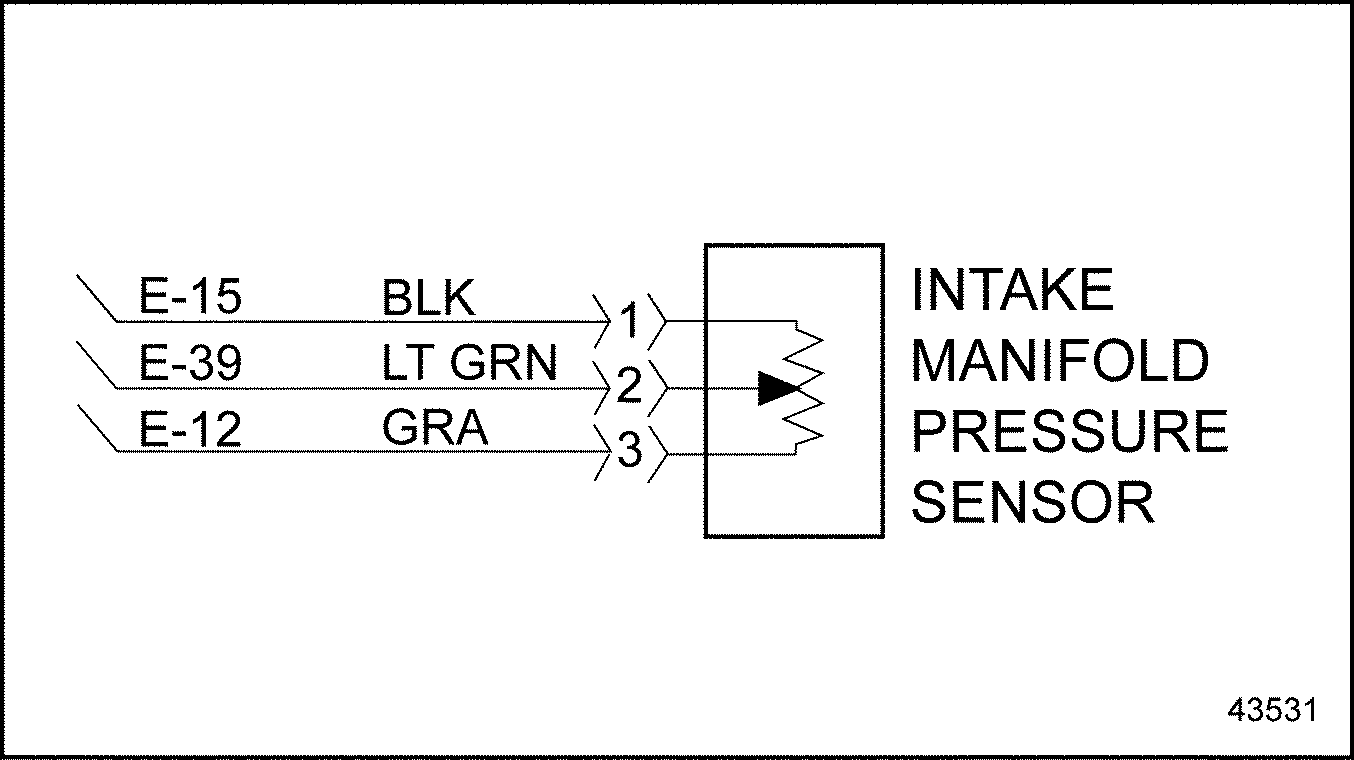
Figure 1. Turbo Boost/Intake Manifold Pressure Sensor
- Check terminals at the TBS/IMP Sensor connectors (both the TBS/IMP Sensor and harness side) for damage: bent, corroded and unseated pins or sockets.
- If the terminals and connectors are damaged, repair them. Refer to "38.2.8.1 Verify Repairs" .
- If the terminals and connectors are not damaged, replace the TBS/IMP Sensor. Refer to "38.2.8.1 Verify Repairs" .
Section 38.2.3
Check for +5 Volt
Perform the following steps to check for +5 volt.
- Remove jumper.
- Turn ignition ON.
- Measure voltage on TBS/IMP Sensor harness connector, pin 1 (red lead) to pin 3 (black lead).
- If the voltage measurement is greater than 6 volts, refer to "38.2.8 Check for Short to Battery +" .
- If the voltage measurement is between 4 and 6 volts, refer to "38.2.4 Check for Signal Open" .
- If the voltage measurement is less than 4 volts, refer to "38.2.6 Check for Open +5 Volt Line" .
Section 38.2.4
Check for Signal Open
Perform the following steps to check for signal open.
- Turn vehicle ignition OFF.
- Disconnect the Engine Harness connector at the ECM/ECU.
- Install a jumper wire between pins 1 and 2 of the TBS/IMP Sensor harness connector. See Figure "Turbo Boost/Intake Manifold Pressure Sensor" .
- Measure resistance between sockets E-39 and E-15 on the Engine Harness connector.
- If the resistance measurement is less than or equal to 5 Ω, refer to "38.2.5 Check for Short" .
- If the resistance measurement is greater than 5 Ω, or open, and the signal line (E-39) is open, repair the open. Refer to "38.2.8.1 Verify Repairs" .
Figure 2. Turbo Boost/Intake Manifold Pressure Sensor
Section 38.2.5
Check for Short
Perform the following steps to check for short.
- Remove jumper.
- Measure resistance between pins 1 and 2 on the TBS/IMP Sensor harness connector.
- If measured resistance between pins 1 and 2 is greater than 100 Ω, or open, go to step 3 .
- If measured resistance between pins 1 and 2 is less than 100 Ω, the signal line (E-39) is shorted to the return line (E-15). Repair the short. Refer to "38.2.8.1 Verify Repairs" .
- Also measure resistance between socket 2 and a good ground.
- If measured resistance between socket 2 and a good ground is greater than 100 Ω, or open, go to step 4 .
- If measured resistance between socket 2 and a good ground is less than 100 Ω, the signal line (E-39) is shorted to the battery ground. Repair the short and refer to "38.2.8.1 Verify Repairs" .
- Check terminals at the ECM/ECU harness connector (both ECM/ECU and harness side) for damage: bent, corroded, and unseated pins or sockets. See Figure
"Turbo Boost/Intake Manifold Pressure Sensor"
.
- If terminals and connectors are damaged, repair them and refer to "38.2.8.1 Verify Repairs" .
- If terminals and connectors are not damaged, install a test ECM/ECU. Refer to "38.2.8.1 Verify Repairs" .
Figure 3. Turbo Boost/Intake Manifold Pressure Sensor
Section 38.2.6
Check for Open +5 Volt Line
Perform the following steps to check for open +5 volt line.
- Turn vehicle ignition OFF.
- Disconnect the Engine Harness connectors at the ECM/ECU.
- Install a jumper wire between pins 1 and 3 of the TBS/IMP Sensor harness connector. See Figure "ECM/ECU Engine and Vehicle Connector" .
- Read resistance between sockets E-15 and E-12 on the Engine Harness connector.
- If the resistance measurement is less than or equal to 5 Ω, refer to "38.2.7 Check for Short" .
- If the resistance measurement is greater than 5 Ω, or open, the ECM/ECU +5 volt line (E-12) is open. Repair open. Refer to "38.2.8.1 Verify Repairs" .
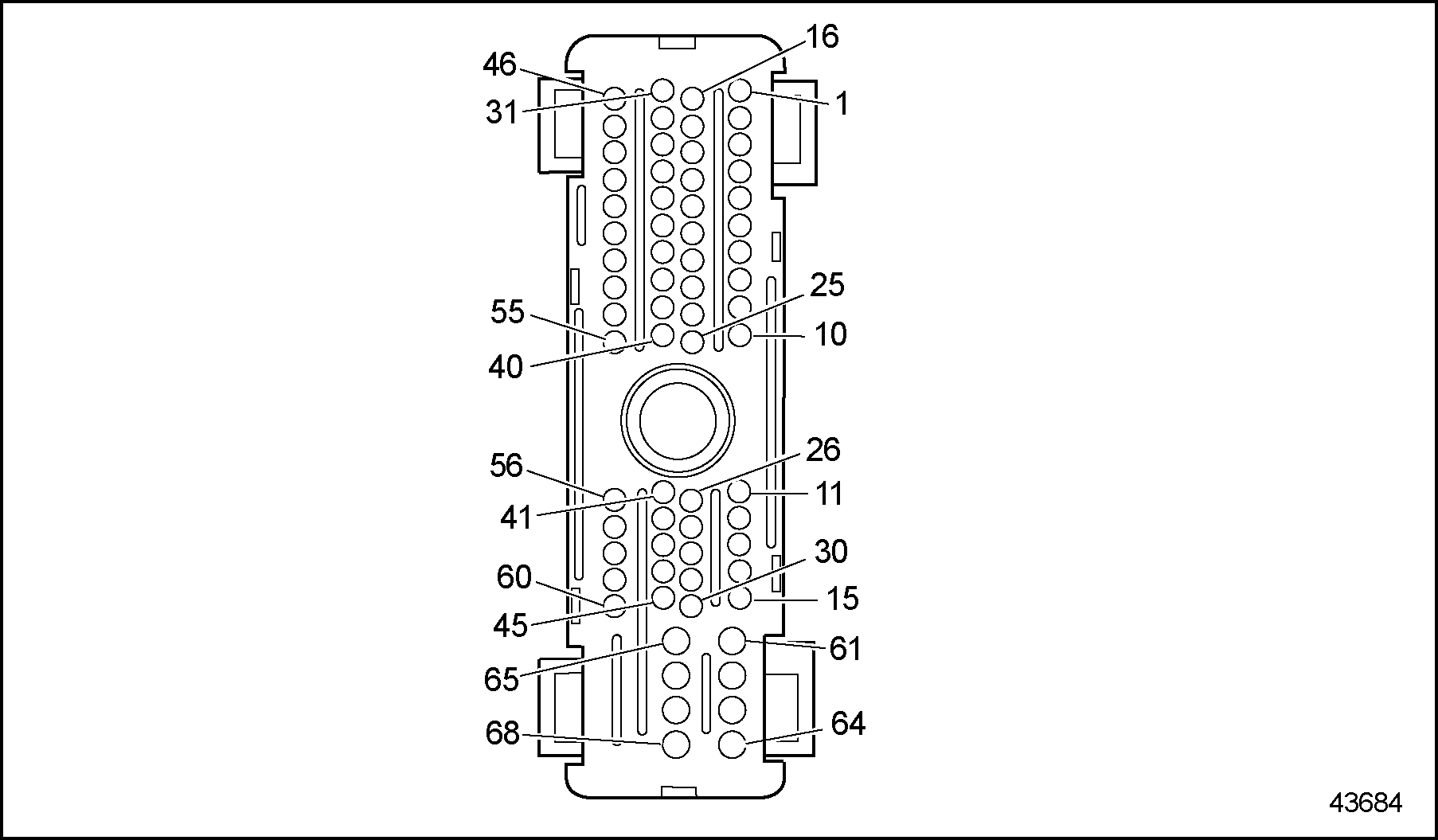
Figure 4. ECM/ECU Engine and Vehicle Connector
Section 38.2.7
Check for Short
Perform the following steps to check for short.
- Remove jumper.
- Measure resistance between pins 1 and 3 on the TBS/IMP Sensor harness connector. See Figure
"Turbo Boost/Intake Manifold Pressure Sensor"
.
- If measured resistance between pins 1 and 3 is greater than 100 Ω, or open, go to step 3 .
- If measured resistance between pins 1 and 3 is less than 100 Ω, the 5 volt supply (E-12) is shorted to the return line (E-15). Repair the short. Refer to "38.2.8.1 Verify Repairs" .
- Also measure resistance between socket 3 and a good ground.
- If measured resistance between socket 3 and a good ground is greater than 100 Ω, or open, go to step 4 .
- If measured resistance between socket 3 and a good ground is less than 100 Ω, the 5 volt supply (E-12) is shorted to the battery ground. Repair the short and refer to "38.2.8.1 Verify Repairs" .
- Check terminals at the ECM/ECU harness connector (both ECM/ECU and harness side) for damage: bent, corroded, and unseated pins or sockets. See Figure
"Turbo Boost/Intake Manifold Pressure Sensor"
.
- If terminals and connectors are damaged, repair them and refer to "38.2.8.1 Verify Repairs" .
- If terminals and connectors are not damaged, install a test ECM/ECU. Refer to "38.2.8.1 Verify Repairs" .
Section 38.2.8
Check for Short to Battery +
Perform the following steps to check for short to battery +.
- Turn vehicle ignition OFF.
- Remove both fuses to the ECM/ECU.
- Disconnect the Engine Harness and Vehicle Interface Harness at the ECM/ECU.
- Measure resistance between socket E-12 on the Engine Harness connector and socket V-15 of the Vehicle Interface Harness connector, and between E-12 and V-61 and V-65. See Figure
"ECM/ECU Engine and Vehicle Connector"
.
- If measured resistance is less than or equal to 100 Ω, a short exists between sockets where less than 100 Ω was measured. Repair short and reinsert fuses. Refer to "38.2.8.1 Verify Repairs" .
- If the resistance measurement is greater than 100 Ω, or open, go to step 5 .
- Check terminals at the ECM/ECU harness connector (both ECM/ECU and harness side) for damage: bent, corroded, and unseated pins or sockets. See Figure
"Turbo Boost/Intake Manifold Pressure Sensor"
.
- If terminals and connectors are damaged, repair them and refer to "38.2.8.1 Verify Repairs" .
- If terminals and connectors are not damaged, install a test ECM/ECU. Refer to "38.2.8.1 Verify Repairs" .
Section 38.2.8.1
Verify Repairs
Perform the following steps to verify repairs.
- Turn vehicle ignition OFF.
- Reconnect all connectors.
- Turn ignition ON.
- Clear codes.
- Start and run the engine for one minute.
- Stop engine.
- Check diagnostic tool for codes.
- If no codes are logged, no further troubleshooting is required.
- If code p 102/4 and any other codes are logged, all system diagnostics are complete. Please review this section from the first step to find the error. Refer to "38.2.1 Multiple Code Check" .
- If code p 102/4 is not logged and any other codes are logged, refer to "18.3 First Step for Diagnosing a Fault Within the DDEC System" .
| Series 60 DDEC V Troubleshooting Guide - 6SE570 |
| Generated on 10-13-2008 |